
You’ve spent months perfecting your product. It’s sleek, functional, and beautiful. Then it arrives at the customer’s door with a cracked screen or a dented corner. The culprit? Not bad handling, but poor transit protection that added unnecessary bulk to the shipping cost. Most designers think protecting a device means wrapping it in three inches of foam. But modern shock and vibration design is about energy management, not just material volume.
Why does this matter? Because heavy packaging kills margins. A 2019 study by the Institute of Packaging Professionals found that oversized packaging increases shipping costs by up to 30% due to dimensional weight rules. You don’t need more stuff; you need better structure. This guide breaks down how to engineer protection that survives the drop test without turning your box into a brick.
Understanding the Enemy: Shock vs. Vibration
Before you pick a material, you need to know what you’re fighting against. In logistics, two distinct forces damage products: shock and vibration. They are not the same, and they require different defenses.
Shock is a sudden, high-intensity impact. Think of a package being dropped from a conveyor belt onto a concrete floor. This event happens in milliseconds. The force is massive, but short-lived. Your packaging needs to absorb this peak energy instantly to prevent internal components from snapping.
Vibration, on the other hand, is a sustained, lower-intensity oscillation. This occurs during truck transport on rough roads or air freight turbulence. While each individual vibration cycle isn’t strong enough to break a phone case, thousands of cycles over hours can loosen screws, fatigue solder joints, or cause "fretting corrosion" in connectors. If you only design for drops, your product might fail after a long haul.
| Feature | Shock (Impact) | Vibration (Oscillation) |
|---|---|---|
| Duration | Milliseconds (<10ms) | Seconds to Hours |
| Frequency | Broadband / Low Frequency | Narrowband / Specific Hz |
| Primary Damage | Cracking, denting, fracture | Loosening, fatigue, wear |
| Best Defense | High-density cushioning | Damping materials, secure fit |
The Myth of Bulk: Why More Foam Isn’t Better
There is a persistent belief in packaging design that thicker foam equals safer products. This is a dangerous oversimplification. Adding bulk doesn’t just increase weight; it changes the physics of the drop. When you have too much space between the product and the box wall, the product has room to accelerate before hitting the cushion. This is called "secondary impact." The product hits the first layer of foam, bounces back, and hits the second layer harder than if it had been snugly fitted.
Furthermore, bulk hurts sustainability metrics. Consumers increasingly judge brands by their environmental footprint. A small Bluetooth speaker shipped in a shoebox-sized container feels wasteful. It signals to the buyer that the company didn’t think carefully about the experience. Efficient design uses geometry rather than mass to solve problems. You want the minimum amount of material necessary to keep the acceleration below the damage threshold of your specific device.
Material Science: Choosing the Right Dampener
Not all cushions are created equal. The key metric here is Energy Absorption Efficiency. This measures how much energy a material can absorb per unit of thickness. High efficiency means you can use less material for the same protection.
Expanded Polyethylene (EPE) is often overlooked in favor of the more common Expanded Polystyrene (EPS), but EPE offers superior resilience. Unlike EPS, which crumbles after one big hit, EPE can be compressed repeatedly and return to its original shape. This makes it ideal for devices that might be returned or re-shipped. However, EPE is expensive. Use it strategically-only in high-stress zones like corners or around fragile lenses.
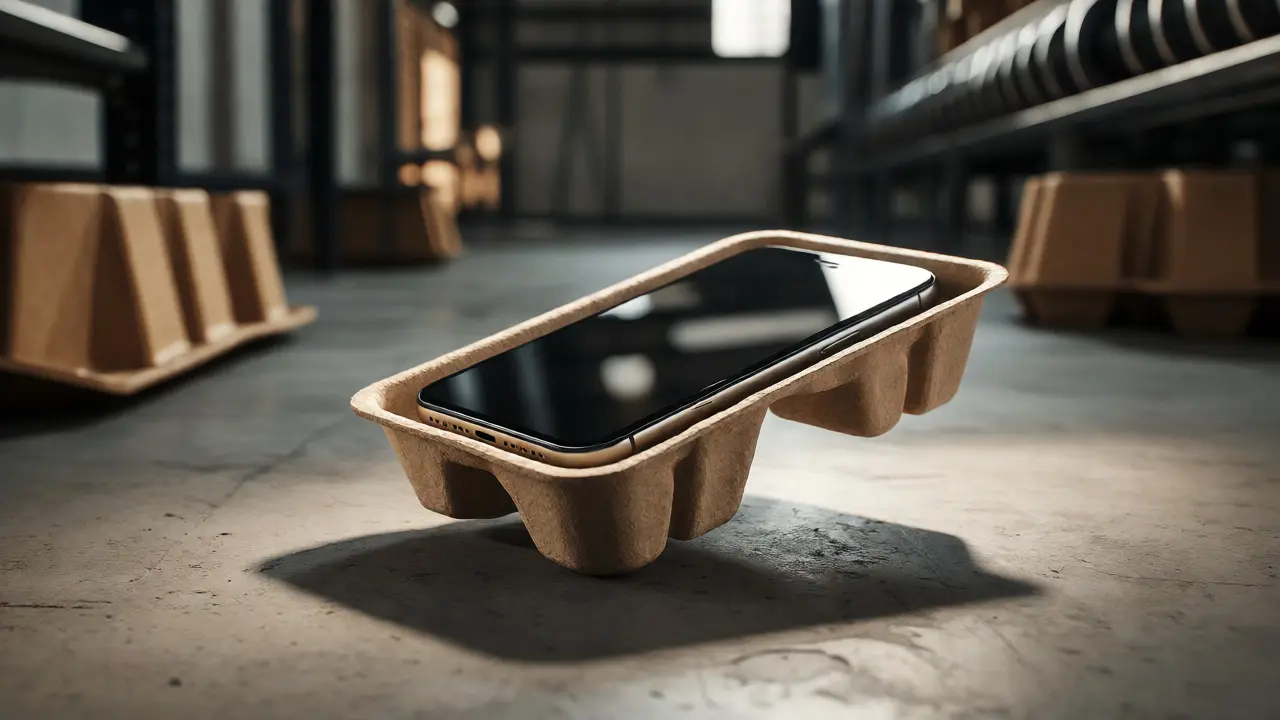
Molded Pulp is making a comeback thanks to advances in fiber engineering. Traditional pulp was rough and inconsistent. Newer designs, using sugarcane bagasse or recycled cardboard, offer precise tolerances. Molded pulp is excellent for vibration damping because its fibrous structure dissipates energy through friction between fibers. It’s also fully biodegradable, which solves the bulk disposal problem. For electronics under $50, molded pulp trays are often the best balance of cost and protection.
Air Cushions (like those used by Amazon) provide exceptional shock absorption with almost zero weight. The air acts as a spring. The downside? They are susceptible to punctures. If your device has sharp edges, air pillows will fail. Always pair air cushions with a rigid outer shell or use them only for smooth-surfaced products.

Structural Strategies: Geometry Over Mass
If you want to reduce bulk, look at the shape of your packaging. Flat surfaces transmit shock directly to the product. Curved or ribbed structures distribute force across a wider area. Consider corrugated flutes. The standard B-flute (approx. 3mm thick) is great for stacking strength but poor for shock. An E-flute (1.5mm) looks sleek but crushes easily. The secret weapon is the double-wall corrugate (BC flute). It provides the rigidity of a hard box with the cushioning properties of a soft pack, allowing you to eliminate separate foam inserts entirely for many mid-range electronics.
Another technique is tension fitting. Instead of relying on foam to hold the product in place, use the tension of the packaging material itself. Vacuum-formed blisters made from thin PETG plastic can hold a device securely against the box walls. This eliminates the "rattle" that causes vibration damage. If the product cannot move, it cannot build up kinetic energy. This method saves significant volume compared to foam blocks.
Testing Without Guesswork: ISTA Standards
You can’t manage what you don’t measure. Many startups skip testing, assuming their design is "good enough." Then they face a 15% return rate due to damage. To avoid this, follow the ISTA (International Safe Transit Association) protocols. You don’t need a million-dollar lab to start.
- ISTA 1A: A basic non-simulation test. It involves dropping the package from specific heights based on its weight. It’s cheap and fast. If your prototype passes ISTA 1A, you’re in the game.
- ISTA 3A: This simulates real-world parcel delivery. It includes vibration tables, compression tests, and random drops. This is the gold standard for e-commerce. If you sell via FedEx or UPS, aim for ISTA 3A compliance.
- Drop Test Angles: Don’t just drop it flat. Drop it on corners and edges. Corners are the weakest points in most packaging structures. A flat drop might pass, while a corner drop shatters the screen.
Pro Tip: Mark your prototypes with tape. After a drop test, check where the tape tore. That tear line shows exactly where the stress concentrated. Reinforce that specific spot with an extra layer of corrugate or a denser foam pad, rather than padding the whole box.

Case Study: The Smartphone vs. The Laptop
Let’s apply these principles to two common devices. A smartphone is small, dense, and fragile. It has a low mass, so it doesn’t generate huge impact forces, but its glass screen is brittle. For smartphones, minimalism wins. A thin, molded pulp tray inside a slim corrugated sleeve is sufficient. The tight fit prevents movement. Adding thick foam actually hurts here because it allows the phone to shift slightly within the foam pocket during vibration, causing micro-abrasions.
A laptop is larger, heavier, and contains moving parts (fans, hinges). It requires robust vibration isolation. Here, you need a suspended chassis effect. Use four corner pads made of high-density polyethylene (HDPE) foam. These pads act as springs. Between the laptop and the outer box, add a layer of cross-linked polyethylene (XPE) sheet to dampen high-frequency vibrations from truck engines. The total thickness might be 20mm, but because it’s localized to corners and sheets, it’s far lighter than a solid block of styrofoam.
Common Pitfalls to Avoid
Even experienced designers fall into traps. One major issue is ignoring humidity. Cardboard loses strength when wet. If your product ships internationally, consider a moisture barrier liner. Another mistake is over-relying on brand recognition. Customers treat unbranded boxes roughly. Treat every package as if it’s being thrown by a stranger who doesn’t care about your logo.
Also, watch out for "void fill" abuse. Filling empty space with packing peanuts seems smart, but loose peanuts create static electricity and allow the product to roll around. If you must use void fill, ensure it completely immobilizes the product. Otherwise, remove the empty space by resizing the box. Custom-sized boxes are cheaper to ship than large boxes filled with junk.
What is the difference between shock and vibration in packaging?
Shock is a sudden, high-force impact like a drop, lasting milliseconds. Vibration is a continuous, lower-force oscillation during transport, lasting hours. Shock causes immediate breakage; vibration causes fatigue and loosening over time.
Is molded pulp better than styrofoam for electronics?
For vibration damping and sustainability, yes. Molded pulp is biodegradable and good at absorbing sustained vibrations. Styrofoam (EPS) is better for single-event shock absorption but is brittle and environmentally unfriendly. Many premium brands now use molded pulp for both benefits.
How do I test my packaging without expensive equipment?
Start with the ISTA 1A protocol. Drop the packaged product from heights specified by its weight (e.g., 24 inches for packages under 10 lbs) onto a concrete floor. Test multiple orientations: flat, edge, and corner. Inspect the product for damage after each drop.
Does thicker foam always mean better protection?
No. Excessive foam can allow the product to accelerate before hitting the cushion, leading to secondary impacts. It also adds weight and shipping costs. Optimal protection comes from the right density and fit, not just thickness.
What is dimensional weight and why does it matter for packaging design?
Dimensional weight (DIM weight) is a pricing technique used by carriers where they charge based on package volume rather than actual weight. If your packaging is bulky but light, you pay more. Reducing bulk lowers DIM weight, directly cutting shipping costs.