
Most companies think more options mean more sales. Apple thinks differently. While competitors flood the market with dozens of phone models, laptops with six storage tiers, and color variants for every season, Apple keeps its lineup tight. And that’s not an accident. It’s the core of how they stay ahead.
Why Fewer Products Mean More Power
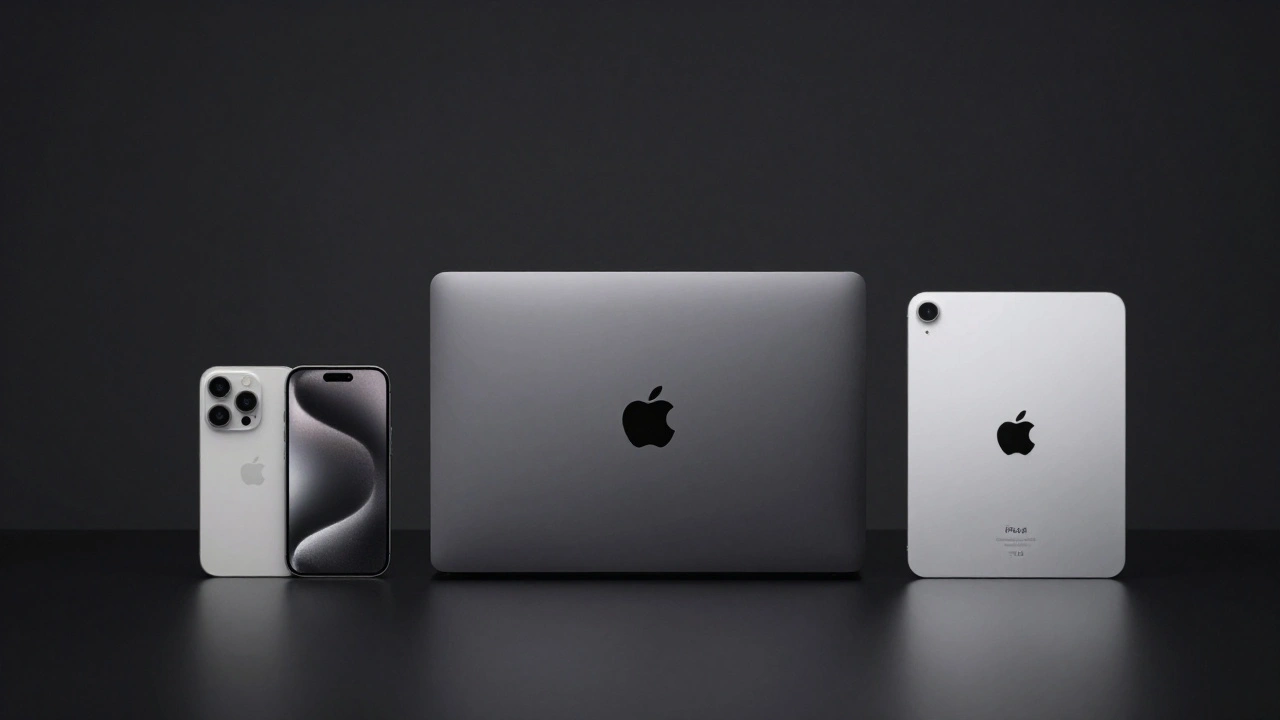
Think about your last phone upgrade. Did you pick between 12 models? Or did you look at two or three? Apple doesn’t give you 12. It gives you one that feels like the right one. That’s not luck. It’s design.Apple’s approach to Stock Keeping Units (SKUs)-the individual versions of a product-is one of the most disciplined in tech. In 2015, while Apple doubled its product categories from 12 to over 24 models, it kept the number of variants within each category razor-thin. For example, the iPhone lineup rarely exceeds 100 total SKUs across all colors, storage sizes, and carrier versions. Most companies would kill for that kind of control. Apple treats it as a baseline.
Why? Because complexity kills efficiency. Every extra SKU adds cost: more parts to source, more factory lines to run, more inventory to track, more customer service questions. Apple cuts that noise. It doesn’t just save money-it buys time. Time to perfect. Time to innovate. Time to make something that doesn’t just work, but feels inevitable.
The One Job Rule
Phil Schiller once said something that changed how we understand Apple. He didn’t talk about specs or features. He talked about jobs.Each Apple product has one job: to make you feel like you don’t need a bigger, more expensive one. That’s it.
That’s why the iPhone 15 Pro doesn’t feel like a step up from the iPhone 15-it feels like the same phone, just better. It’s not about upgrading. It’s about completing. The iPad Air isn’t a cheaper iPad. It’s the iPad for people who want the full experience without the weight. The MacBook Air isn’t a stripped-down laptop. It’s the laptop for people who move.
This isn’t marketing fluff. It’s design logic. When you limit options, you force clarity. You stop trying to please everyone. You start serving one kind of person, really well. And when you do that, that person becomes loyal. Not because they’re trapped. Because they feel understood.
How Constraints Fuel Innovation
Most tech companies chase trends. They add features because competitors did. They release new models every six months because investors demand growth.Apple does the opposite. It slows down to speed up.
With fewer SKUs, Apple can pour all its resources into a handful of products. That means better materials. Tighter software integration. More precise manufacturing. The M3 chip doesn’t just power a MacBook. It powers the MacBook. There’s no diluted version. No compromise model. Just one version that does everything right.
Compare that to Android phone makers who release 50+ models a year. Each one has slightly different cameras, slightly different batteries, slightly different software. Customers get confused. Retailers get overwhelmed. Support teams drown in questions.
Apple’s constraint isn’t a limitation. It’s a filter. It removes noise. It forces focus. And that focus turns into quality you can’t fake.
The Pricing Engine Behind the Limitation
Apple doesn’t discount. Ever.When a new iPhone drops, the old one disappears. No clearance sales. No "last chance" deals. Why? Because price cuts kill perception. If customers think Apple products will drop in price next month, they wait. And if they wait, Apple loses control of its ecosystem.
Instead, Apple uses Minimum Advertised Price (MAP) policies. Retailers can’t undercut the price. That keeps the value locked in. Customers don’t compare prices across models. They compare value across needs. And because there are so few models, the comparison is simple: Do you need this one? Or not?
This isn’t about greed. It’s about control. Apple’s premium pricing works because its product range is narrow. If you had 15 iPhone models, you’d have 15 different price points. Some would be too close. Others would bleed into each other. Customers would hesitate. Apple avoids that entirely.
The result? Apple captures over 70% of global smartphone profits-despite selling less than 15% of all phones. That’s not magic. That’s math. Fewer SKUs. Higher margins. Stronger loyalty.
The Ecosystem That Only Works Because It’s Small
Apple’s real superpower isn’t the iPhone. It’s the ecosystem.Hand off a photo from your iPhone to your iPad. Start a message on your Mac and finish it on your Apple Watch. Your notes, your calendar, your reminders-all synced, instantly, without you thinking about it.
That only works because Apple controls the entire chain. No third-party hardware. No fragmented software. No 20 different versions of AirDrop.
If Apple made 50 iPad models, each with different chips, OS versions, and connectivity options, that ecosystem would collapse. Compatibility breaks. User experience frays. Trust erodes.
By keeping SKUs low, Apple ensures every device speaks the same language. That’s not an accident. It’s intentional design. The fewer products, the tighter the weave. And the tighter the weave, the harder it is to pull apart.
Why Competitors Can’t Copy This
You’ll hear people say Apple’s strategy is only possible because it’s rich. That’s wrong.Apple’s constraint strategy works because it’s opposite of what most companies do. Most brands grow by adding SKUs. Apple grows by removing them.
Look at Samsung. They have hundreds of SKUs across phones, tablets, wearables, and home devices. They compete on specs. On price. On variety. But they also have massive inventory problems. They overproduce. They discount. They confuse customers.
Apple doesn’t need to be everywhere. It needs to be right everywhere. And that’s only possible when you say no to most things.
Even Tesla, often compared to Apple, still offers multiple trims, battery sizes, wheel options, and software packages. Apple doesn’t. It doesn’t need to. Its customers don’t ask for it. And that’s the point.
What This Means for Designers
This isn’t just a tech story. It’s a design story.Constraints aren’t enemies. They’re tools. The best designers don’t start with "what can we add?" They start with "what can we remove?"
Apple’s product teams don’t ask: "How many features can we fit?" They ask: "What’s the one thing this product must do, perfectly?"
That’s the real lesson. When you limit choices, you sharpen focus. When you remove noise, you amplify signal. When you say no to 99 things, you say yes to something extraordinary.
Design isn’t about options. It’s about intention.
| Aspect | Apple | Typical Consumer Electronics Brand |
|---|---|---|
| iPhone SKUs per generation | 3-5 (storage + color) | 10-20+ (storage, color, carrier, regional) |
| Total product SKUs (all categories) | Under 100 | 500-5,000+ |
| Inventory turnover rate | ~50x/year | ~5-15x/year |
| Price discipline | Strict MAP policy, no discounts | Frequent sales, promotions, clearance |
| Product lifecycle | 12-18 months before discontinuation | 6-12 months before phase-out |
What Happens When Apple Breaks Its Own Rule?
There was one moment Apple nearly did. In 2013, it launched the iPhone 5C-a colorful, plastic iPhone aimed at budget buyers. It was a SKU expansion. A departure.It failed.
Not because it was bad. But because it confused the brand. People didn’t see it as "a cheaper iPhone." They saw it as "a lesser iPhone." Sales dropped. Apple quietly retired it within a year.
That moment proved the rule: once you dilute the constraint, you dilute the value.
Apple didn’t need the 5C. It didn’t need to chase the "mass market." It chose to serve the market it already had-and make it deeper.
Why This Works Now-More Than Ever
In 2026, consumers are overwhelmed. There are more gadgets, more apps, more choices than ever. People aren’t looking for more. They’re looking for clarity.Apple’s strategy doesn’t just make business sense. It makes emotional sense.
When you remove complexity, you give people peace. When you remove noise, you give them focus. When you remove doubt, you give them confidence.
That’s why Apple’s limited SKUs aren’t a cost-cutting trick. They’re a psychological lever. They don’t just sell phones. They sell certainty.
Why doesn’t Apple make a cheaper iPhone?
Apple doesn’t make a cheaper iPhone because it doesn’t need to. Its goal isn’t market share-it’s profit per user. By keeping the iPhone line focused on premium models, Apple avoids the "junk market" of low-margin, high-volume sales. Instead, it builds loyalty among users who value quality, ecosystem integration, and long-term software support. The company has proven it can grow revenue without expanding into budget segments.
Does Apple’s limited SKU strategy hurt innovation?
No-it fuels it. With fewer products to manage, Apple can invest more deeply in each one. The M-series chips, Face ID, and ProMotion displays weren’t rushed out across ten models. They were perfected in one, then refined over time. Constraint forces prioritization. That’s why Apple’s innovations feel more intentional and lasting than competitors’.
How does Apple manage inventory with so few SKUs?
Apple’s supply chain is built around predictability. With only a handful of SKUs, Apple can forecast demand with 90%+ accuracy. It manufactures in centralized hubs, uses just-in-time delivery, and eliminates excess stock. This lets Apple turn inventory over 50 times a year-far faster than the industry average of 5-15. Less stock means less risk, less waste, and more flexibility to launch new products.
Can other companies copy Apple’s SKU strategy?
They can try, but few succeed. Apple’s strategy works because it’s backed by decades of brand trust, vertical integration, and design discipline. Competitors rely on volume, retail partnerships, and price cuts to compete. Apple doesn’t. It’s not about copying the number of SKUs-it’s about adopting the mindset: fewer choices, deeper excellence.
What happens if Apple adds more SKUs?
History shows it risks brand erosion. The iPhone 5C in 2013 was Apple’s only major SKU expansion-and it failed quickly. Customers saw it as a downgrade, not a choice. Apple learned: once you blur the line between premium and basic, you lose the premium. The company’s continued success proves it won’t repeat that mistake.
Final Thought: Design Is About Saying No
Apple doesn’t win because it has the best engineers. It wins because it has the clearest vision.Every time it says "no" to a new color, a new storage option, a new variant-it’s not being stubborn. It’s being deliberate.
Design isn’t about adding more. It’s about removing the noise until only the essential remains.
That’s why Apple’s limited SKUs aren’t a constraint.
They’re the reason it still leads.



Categories
Popular Articles