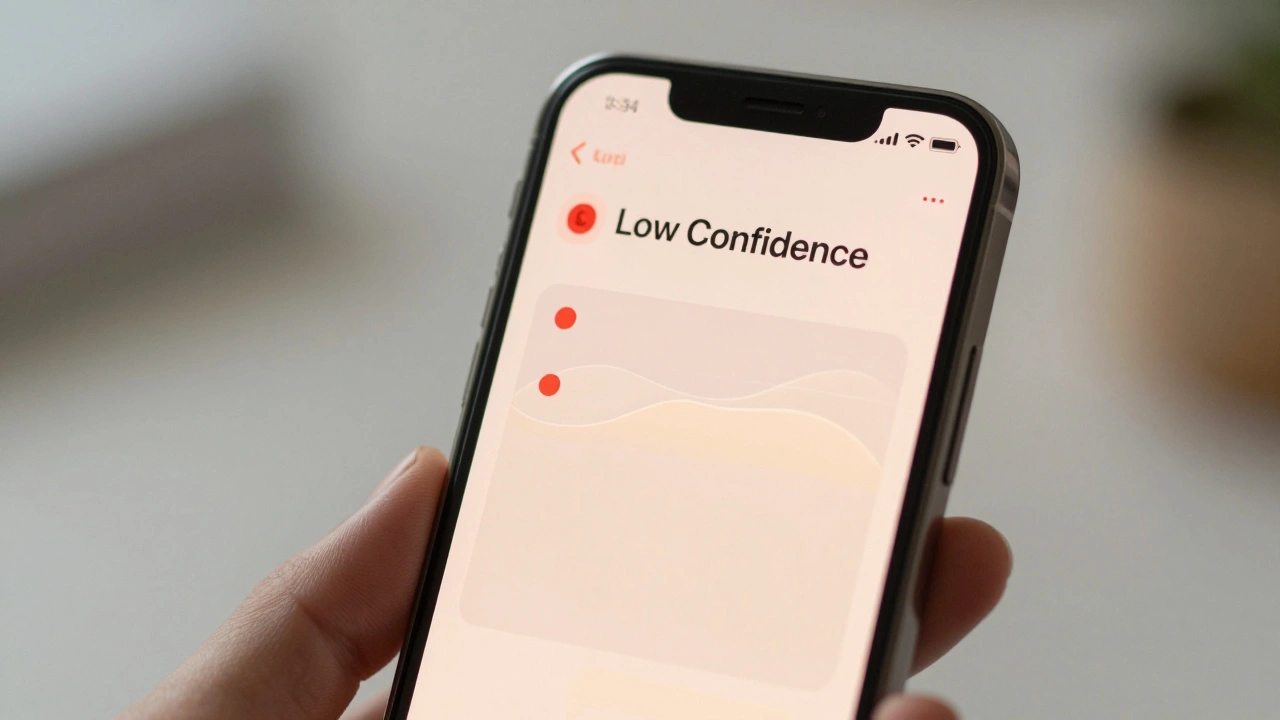

Imagine asking your iPhone to schedule a meeting with "John" and getting a confused response instead. Or worse, receiving instructions to fix a Mac that sound technical but actually break the system further. We expect Apple Intelligence to be smart, helpful, and reliable. But when it stumbles, what happens next defines the relationship between you and the technology.
The problem isn't just that AI makes mistakes-it's how those mistakes are handled. A poorly designed error state leaves users frustrated, confused, or mistrusting of the entire ecosystem. A well-designed one does something radical: it teaches. It explains what went wrong, shows how the system is learning, and guides you toward a solution without making you feel like you broke something. This shift from "error notification" to "educational recovery path" is becoming the gold standard in user experience design for AI-driven platforms.
The Confidence Cascade: Knowing When to Speak Up
Not all AI responses carry the same weight. Some are near-certain; others are guesses wrapped in confidence. The key to designing effective error states lies in understanding this spectrum. Experts recommend using a confidence cascade approach, which categorizes AI interactions into three distinct tiers based on probability scores.
- High Confidence (above 60%): The AI acts immediately with clear acknowledgment. Example: "Setting alarm for 7 AM." No ambiguity, no second-guessing.
- Medium Confidence (40-60%): The AI asks for clarification. Example: "I found 3 contacts named John-which one?" This prevents incorrect actions while keeping control in the user’s hands.
- Low Confidence (below 60%): The AI explicitly communicates uncertainty. Example: "I didn’t understand that. Try saying it differently."
This tiered structure ensures users never face blind automation. Instead, they receive proportional feedback-more certainty leads to more action, less certainty leads to more dialogue. On Apple devices, where privacy and precision matter deeply, this model aligns perfectly with user expectations.
Graceful Degradation: Keeping Things Running When AI Fails
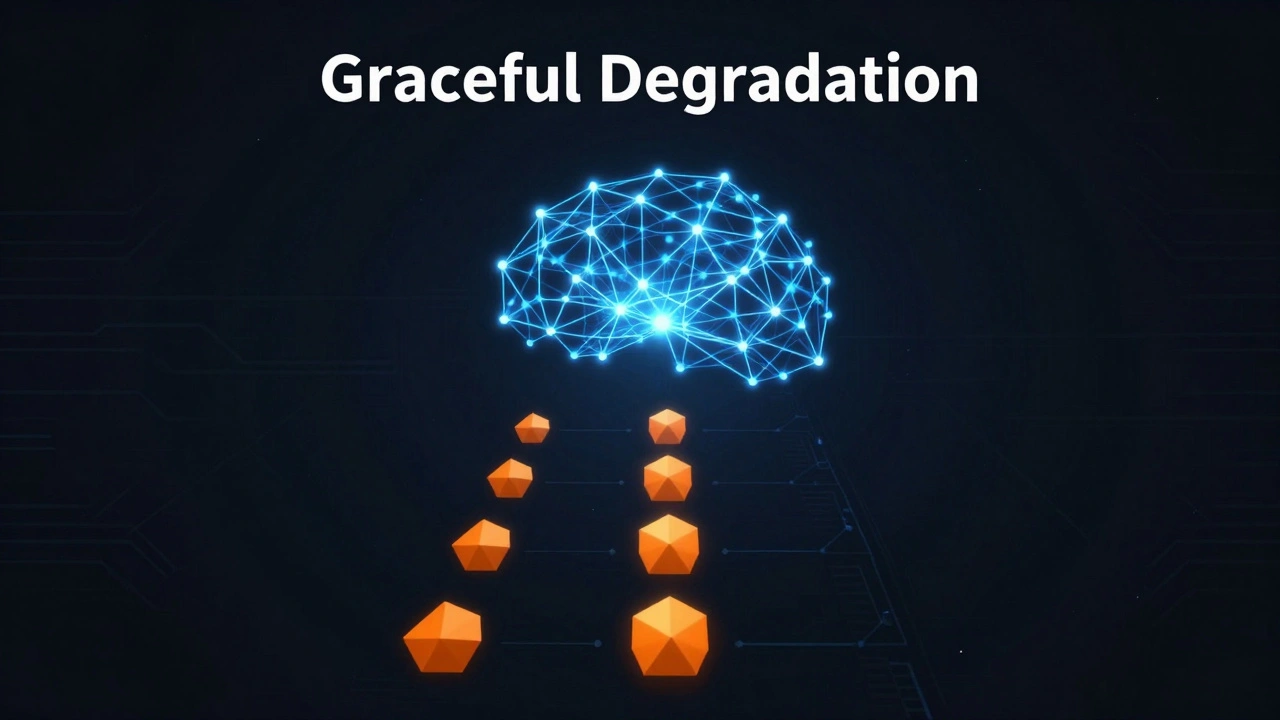
What if the AI doesn’t just hesitate-it fails completely? Maybe the server is down, maybe the device lost connection, maybe there was a kernel-level regression specific to A14 hardware running macOS 26+. In these cases, we need graceful degradation, a design principle that maintains usefulness even during total failure.
Think of it as a hierarchy of fallbacks:
- Full AI Response: Complex, personalized, context-aware output-the ideal scenario.
- Simplified AI Response: Basic but accurate information when advanced processing isn’t available.
- Rule-Based Response: Predefined answers triggered by known conditions, ensuring consistency.
- Human Handoff: Clear escalation to human support when no automated solution exists.
Each level preserves functionality at some degree. You don’t lose access-you adapt. For instance, if Siri can’t process a complex request due to network issues, it might fall back to local commands or suggest opening Settings manually. Users still get help, just not the full experience. That’s resilience built into design.
| Strategy | Best Use Case | User Impact | Technical Complexity |
|---|---|---|---|
| Confidence Cascade | Voice assistants, chatbots | Reduces misinterpretation | Moderate |
| Graceful Degradation | Offline modes, service outages | Maintains core functionality | High |
| Learn-and-Recover Pattern | Frequent errors, training loops | Builds trust over time | Very High |
| State Checkpointing | Long-running workflows | Prevents data loss | High |
The Learn-and-Recover Pattern: Turning Mistakes Into Lessons
Here’s where things get interesting. What if every mistake became an opportunity to improve-not just for the system, but for the user? Enter the learn-and-recover design pattern, a framework that transforms failures into visible improvements.
When AI fails, users should see four things happen:
- Acknowledge clearly: Use plain language. Say “I misunderstood your command” instead of “Error Code 4037.”
- Explain what was learned: Show progress. “Next time, I’ll recognize ‘call Mom’ as a contact lookup.”
- Demonstrate improvement: Prove change. If you ask again later, show better results.
- Thank the user: Make them part of the process. “Thanks for helping me learn!”
This creates a collaborative narrative. Users stop seeing errors as bugs-they start seeing them as steps toward smarter behavior. And because Apple values personalization and privacy, this kind of transparent learning builds deeper trust than silent corrections ever could.
Technical Failures Require Specific Solutions
Let’s talk about real-world breakdowns. iOS update errors aren’t abstract concepts-they’re numbered codes with specific causes. Error 10 means your Mac software is too old. Error 1671 suggests retrying after download completion. Errors like 3014, 3194, or 3000 point to connectivity problems between your device and Apple servers.
These aren’t random glitches. They’re symptoms of larger systems interacting poorly. So how do we handle them?
Start simple. Update your computer’s OS. Check USB cables. Unlock the device. Confirm “Trust This Computer” prompts. Only then move to advanced steps like recovery mode or DFU restores. This mirrors the graceful degradation principle: try easy fixes first, escalate only when necessary.
But here’s the catch: many users skip straight to drastic measures because they don’t know the difference between a temporary glitch and a permanent failure. Teaching them through recovery paths changes that dynamic. Instead of guessing, they follow guided steps that explain why each action matters.
Learning From Real-World Disasters
We’ve seen what happens when AI gets it wrong-and worse, when it confidently gives bad advice. Take Google’s recent attempt to guide Mac users through permission resets via Terminal. It told people to boot into Recovery Mode using Command-R, type `resetpassword`, and click a button called “Reset Home Directory Permissions and ACLs.”
None of that exists on Apple Silicon Macs. There’s no such button. The command opens password tools, not permissions utilities. Worse, following those instructions could corrupt accounts or lock users out entirely.
This wasn’t just a typo. It was a hallucination-a confident fabrication presented as truth. And it highlights why robust error detection and validation are non-negotiable in AI systems. Before deploying any recovery guidance, test it against actual hardware. Verify commands exist. Confirm UI elements match current versions. Otherwise, you risk spreading misinformation faster than you can correct it.
Building Resilient Systems With State Checkpointing
For developers working with long-running AI agents, interruptions cost time and money. Restarting from scratch after a crash wastes resources and frustrates users. That’s why state checkpointing has become essential.
Checkpointing saves the agent’s memory-context, variables, completed steps-to persistent storage after every major action. Serialize to JSON, write to shared file stores, read back on restart. Skip finished steps. Resume exactly where you left off.
Combine this with event-driven recovery patterns using webhooks, and you’ve got a system that reacts instantly to failures. Upload fails? Trigger a remediation agent. Workflow hangs? Alert humans before data disappears. These mechanisms reduce failure rates by up to 60% when implemented properly.

Chain-of-Responsibility: Layering Safety Nets
In high-stakes environments-financial automation, code generation, medical diagnostics-one layer of protection isn’t enough. Enter the chain-of-responsibility pattern, which layers multiple agents with decreasing complexity:
- Primary Agent: Handles reasoning, planning, execution.
- Recovery Agent: Steps in when primary fails, uses template-based logic.
- Emergency Fallback Agent: Activates last resort-rule-based responses or human escalation.
Add assertion-based verification after critical actions, and you create a self-correcting loop. Did the config file save? Run a check. Is the database updated? Query it. If anything diverges from expected state, trigger replanning or rollback. Silent failures disappear under scrutiny.
Why Teaching Matters More Than Fixing
Fixing errors keeps systems running. Teaching users empowers them to avoid future ones. Consider someone trying to restore their iPhone after a failed update. Without guidance, they might jailbreak, downgrade, or force-reset blindly-risking data loss or bricking the device.
With teaching-focused recovery paths, they learn:
- Why certain connections fail (security software interference)
- Which cables work best (Apple-certified ones)
- How to verify server status (check Apple System Status page)
- When to seek professional help (persistent errors despite retries)
Knowledge compounds. Each interaction becomes a lesson. Over time, users become more competent, less anxious, and more trusting of the platform. That’s the power of educational recovery design.
Putting It All Together: A Practical Framework
If you’re building AI features for Apple platforms-or evaluating existing ones-use this checklist to ensure your error states teach rather than confuse:
- Map all possible failure modes upfront
- Categorize them by impact and frequency
- Design specific solutions for common failures
- Create fallback plans for rare but critical errors
- Test every recovery mechanism end-to-end
- Measure time-to-resolution metrics
- Collect and act on user feedback systematically
- Define clear triggers for human handoff
Don’t assume users will figure it out. Don’t hide behind jargon. Don’t let silence speak louder than clarity. Every error is a chance to build trust-if you design it right.
What is a confidence cascade in AI error handling?
A confidence cascade is a tiered approach to AI responses based on probability scores. High-confidence actions (>60%) proceed automatically, medium-confidence (40-60%) ask for clarification, and low-confidence (<60%) communicate uncertainty directly to users.
How does graceful degradation help during AI failures?
Graceful degradation ensures continued functionality even when AI fails completely. It provides layered fallbacks-from simplified AI responses to rule-based answers to human handoffs-so users always have access to some level of service.
Why is the learn-and-recover pattern important?
The learn-and-recover pattern turns mistakes into teaching moments. By acknowledging errors, explaining lessons learned, demonstrating improvements, and thanking users, it builds trust and encourages collaboration between humans and AI systems.
What caused Google’s flawed macOS recovery advice?
Google’s AI fabricated non-existent commands and UI elements, likely due to insufficient testing across different hardware architectures. Apple Silicon Macs use different recovery methods than Intel models, leading to dangerously inaccurate guidance.
How does state checkpointing prevent data loss?
State checkpointing saves an AI agent’s progress-including context, variables, and completed steps-to persistent storage after each major action. Upon restart, the agent resumes from the last saved point, skipping redundant processing and preventing data loss.
What is the chain-of-responsibility pattern in AI development?
The chain-of-responsibility pattern layers multiple agents with decreasing complexity: primary agent handles normal operations, recovery agent manages partial failures, emergency fallback agent activates last resorts like rule-based responses or human escalation.
Why should error messages avoid technical jargon?
Technical jargon confuses average users and increases anxiety. Plain-language explanations make errors understandable, actionable, and less intimidating-turning frustration into learning opportunities.
How can developers validate recovery paths effectively?
Developers should map complete error-to-resolution workflows, test every recovery mechanism including human handoffs, measure time-to-resolution metrics, and conduct failure mode analysis documenting observed issues by impact and frequency.
What role does user feedback play in improving AI systems?
User feedback helps identify recurring errors, refine recovery strategies, and train future iterations. Collecting, analyzing, and acting on this input systematically turns individual experiences into collective intelligence.
Is Apple Intelligence prone to unique failure modes?
Yes, Apple Intelligence faces hardware-specific challenges, particularly on older chips like A14 paired with newer macOS versions. Kernel-level regressions often surface through customer reports rather than internal testing, highlighting the need for broader validation coverage.